
6. Inspection and recording
6.1 The plan
Inspection points are places where the robot stands (map frame), each with its targets: where the PTZ camera looks (pan, tilt, zoom) and what is checked there. Points are matched by position, not by route: every route that stops within match_radius_m of a point inspects it.
points:
  - name: bay1_disconnector
    x: 12.40
    y: -3.10
    targets:
      - name: bay1_ds_clamps
        pan_deg: 35.0
        tilt_deg: -10.0
        zoom: 4.0
        thermal: {enabled: true, strips: 3, max_temp_c: 0.0}
        acoustic: {enabled: true, duration_sec: 5.0}
The site’s own file and NETRA’s plan are merged; a NETRA point never replaces a point of the same name in the site’s file.
6.2 At a stop
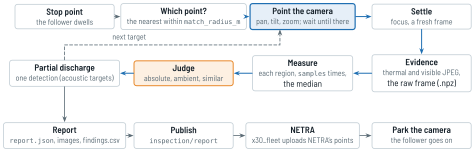
inspection_node answers navigation/stop_point: for each target it moves the camera (hikmicro_ptz_node on the perception host), waits until it settles, takes the temperatures of the regions several times (median), a visible and a thermal image and the raw temperatures, runs the acoustic detection, judges the findings (Tuning Guide, “Inspection”) and publishes one inspection/report. The report folder is written before the message goes out, so the uplink always finds the files it names.
6.3 The recorder
recorder_node on the perception host writes a session per patrol or request:
~/x30/recordings/<YYYYMMDD>/<HHMMSS>_<patrol|manual>/
  session.json              reason, start and end, site, what was recorded (rewritten as it grows)
  thermal/*.npz             a raw frame each: degC per pixel, the pose, pan, tilt, zoom
  video/<stream>_*.mp4      the camera's streams, segment by segment (ffmpeg, RTSP), and their logs
  acoustic/*.npz            the acoustic camera's data in chunks, and detections.jsonl
Files go to the disk through a bounded queue; a full queue drops and counts rather than blocks. The video is copied as the camera encodes it (no re-encoding on the robot).