
1. The system
1.1 What it is
x30_ros turns a Deep Robotics Jueying X30 Pro into an autonomous substation patrol robot: it walks routes taught by an operator, keeps clear of people and obstacles, inspects equipment with a thermal PTZ camera and an acoustic camera at the stop points, records its cameras, and reports to the NETRA command center. It runs on ROS 1 Noetic on the robot’s own computers and replaces Deep Robotics’ autonomy (localization, navigation, mapping), which it turns off; Deep Robotics’ motion control, LiDAR and IMU drivers stay.
It is the Noetic port of Dharma, the robot-agnostic stack shared with Pashupati (ROS 2, mall patrol) and HotDog (ROS 2, substation patrol on a Deep Robotics M20): the same packages, models and protocols, so a handheld or a NETRA that knows one knows the others.
1.2 Hosts and network
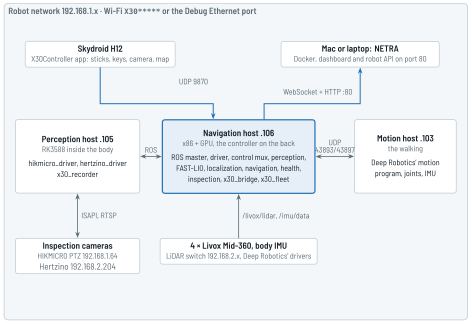
| Host | Address | Runs |
|---|---|---|
| Motion host | 192.168.1.103 | Deep Robotics’ locomotion: gait, joints, its UDP control interface |
| Perception host | 192.168.1.105 | the inspection cameras’ drivers, x30_recorder; Deep Robotics’ elevation map and charging |
| Navigation host (intelligent controller) | 192.168.1.106 | the ROS master (Deep Robotics’), the LiDAR and IMU drivers (Deep Robotics’), and the whole x30_ros stack: driver, mux, scans, odometry, localization, navigation, inspection, health, the handheld gateway, the NETRA uplink |
| HIKMICRO PTZ | 192.168.1.64 | thermal and visible camera (ISAPI, RTSP) |
| Hertzino HZ-FA-371 | 192.168.2.204 | acoustic camera, on the LiDAR network |
| Skydroid H12 | robot’s Wi-Fi | X30Controller, UDP to 9870 |
| NETRA | a laptop or server | the command center, port 80 (HTTP, WebSocket) |
Both robot hosts share one ROS master on the navigation host (ROS_MASTER_URI=http://192.168.1.106:11311), each with its own ROS_IP. The navigation host carries everything that drives or guards the robot, so a perception host busy decoding video never delays a stop.
1.3 Layers
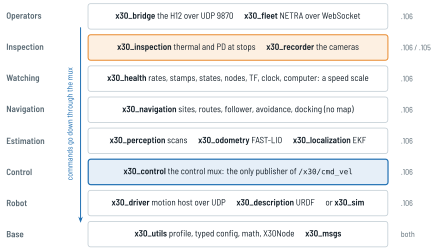
1.4 Principles
- One publisher of
cmd_velevery motion passes the control mux: arbitration, the envelope, the protective field, the e-stop (Chapter 4). - No map the start spot is the origin; routes are taught and repeated in that frame; tags correct the drift. Nothing to build or maintain per site but the routes.
- Pure cores every algorithm lives in a
core/module without ROS, tested on its own; the nodes are thin shells around them. - Typed configuration every parameter declared once with unit, range and meaning, validated at start; live ones re-read every second; the documentation’s tables are generated from them.
- Secrets in the environment tokens and passwords only as environment variables, never as ROS parameters (which
roslaunchprints and the parameter server shares). - Nothing lost offline what NETRA must get waits in a spool on disk; what the robot records stays on its disk until room is needed.