
4. The control mux and the protective field
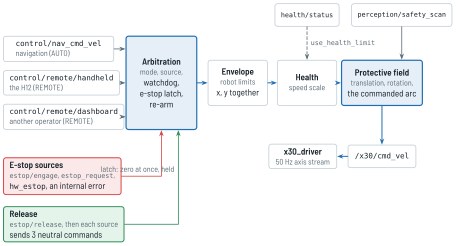
control_mux_node is the only publisher of the robot’s cmd_vel. Every command, from navigation or from an operator, passes through it in this order:
4.1 Sources, silence and the e-stop
- AUTO navigation drives (
control/nav_cmd_vel); a silence longer thannav_timeout_sec(0.5 s) sends one zero. - REMOTE one operator source drives, each on
control/remote/<source>/cmd_vel:handheld(the H12 gateway);dashboardis a second source nothing on the X30 publishes yet; a silence longer thanremote_timeout_sec(0.3 s) sends one zero. - E-stop while engaged, zeros at
estop_hold_hz. After the release, after a mode change or a source’s silence, the source must first sendrearm_neutral_countneutral commands in a row (every axis belowneutral_eps): a stick held during the release never moves the robot.
4.2 The envelope
The command is brought inside the profile’s limits, keeping its direction:
A non-finite value turns the whole command into zero. With use_health_limit, the health monitor’s speed_scale (0 to 1) multiplies every command.
4.3 The protective field
The field limits each command to what the robot can still stop within, on the 360° safety scan (perception/safety_scan, Chapter 5). It applies in AUTO with field.margin, and in REMOTE with field.remote_margin unless field.in_remote is false.
4.3.1 Translation
The footprint, grown sideways by lateral_margin, is swept along the commanded direction of travel; human_speed) covers until the robot stands:
Solved for the highest allowed speed:
A faster command is scaled down to min_speed stops the translation instead (a crawl into an obstacle helps no one).
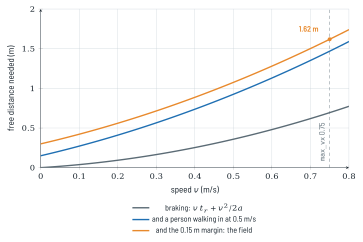
With the X30’s profile (
| Speed | Braking | Person | Field, AUTO | Field, REMOTE |
| m/s | m | m | m ( | m ( |
| 0.10 | 0.04 | 0.23 | 0.42 | 0.37 |
| 0.25 | 0.13 | 0.36 | 0.64 | 0.59 |
| 0.50 | 0.36 | 0.57 | 1.08 | 1.03 |
| 0.75 | 0.69 | 0.78 | 1.62 | 1.57 |
| Free ahead | Allowed, AUTO |
| m | m/s |
| 0.50 | 0.16 |
| 0.75 | 0.32 |
| 1.00 | 0.46 |
| 1.25 | 0.59 |
| 1.50 | 0.70 |
| 2.00 | 0.90 |
4.3.2 Rotation
For a turn, the field finds the angle yaw_margin, and allows the yaw rate that stops within it:
Below min_yaw_rate the turn stops. A command that translates and turns at once is checked along its stopping arc: the footprint at every step of the arc until both axes stand, with the margin grown by the person’s approach during the braking time
4.3.3 When the scan cannot be trusted
| State | Behaviour |
|---|---|
| STALE | no scan newer than scan_timeout_sec, or its stamp older than scan_max_age_sec: AUTO stops; REMOTE creeps, the fastest point of the body at remote_degraded_speed |
| BLIND | the LiDAR sees too little (Chapter 5): AUTO stops; REMOTE creeps and still keeps clear of what is seen, never toward a blind sector |
4.4 Tuning the field
marginwhat the model does not know: the scan’s motion smear and its sector discretization (Chapter 5), the robot’s sway while walking. 0.15 m covers the X30 at 0.75 m/s on a 10 Hz scan; raise it on rough ground.human_speedthe trade-off of the whole field. 0.5 m/s presumes trained staff who see the robot. ISO 13855 assumes 1.6 m/s for a walking person: the field at 0.75 m/s then needs 3.3 m free ahead, and the robot slows wherever people may walk. Choose it with the site’s risk assessment, never lower than the people near the robot actually walk.lateral_marginthe sideways allowance of the swept band; the follower’s guard must use at least the same (path_follower_node/safety/lateral_margin).min_speed,min_yaw_ratebelow the X30’s slowest steps (Chapter 3) a command does not move the robot anyway.
The field is software
The protective field is not a certified safety function. It reduces risk; the hard emergency stop and a responsible operator stay the protection.