
7. Localization
7.1 No map: the start spot and the tags
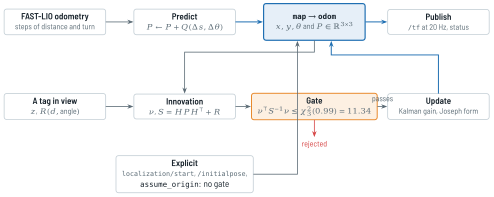
The X30 patrols without a map. The robot starts on its dock; FAST-LIO’s start is the origin of the map frame, and every route is taught and repeated in that frame. Odometry drifts with every metre; tags (printed ArUco markers on walls and posts, recorded once in the site) correct the drift wherever the robot sees one.
localization_node estimates
7.2 The filter
7.2.1 State and prediction
The state is motion_step_m 5 cm, motion_step_deg 2°) so that the sway of a standing robot adds nothing. For a step of
mapped into the state through the inverse of the measurement Jacobian,
7.2.2 Correction
A tag seen from the robot gives a measurement
A measurement with
The Joseph form keeps min_sigma_xy (1 cm) and min_sigma_yaw_deg (0.25°): the filter never becomes so sure of itself that it rejects the next tag.
gate_confidence | 0.95 | 0.99 | 0.999 |
| 7.81 | 11.34 | 16.27 |
7.2.3 How much a tag is trusted
A tag’s pose is less certain the farther and the more obliquely it is seen. For a tag at distance
with sigma_xy_at_1m, sigma_yaw_deg_at_1m). A heading error also moves the robot about the tag, so max_distance_m (4 m) or seen beyond max_view_angle_deg (60°) are ignored: at 4 m a tag’s position is already worth 32 cm.
7.3 The states
- NONE no
yet: navigation does not start. - LOCALIZED the robot knows where it is: on the start spot (
origin_sigma_xy5 cm,origin_sigma_yaw_deg2°), or from a tag. - UNCERTAIN
above max_sigma_xyorabove max_sigma_yaw_deg.
The follower pauses only at NONE. UNCERTAIN is reported on localization/status and by the health monitor, and the patrol goes on: without a map the robot has nothing better than its odometry between tags. The defaults (100 m, 180°) never leave LOCALIZED; lower them to make a long walk without tags visible in NETRA and the health report.
7.4 Tags
- Recording
localization/record_tagsaverages each visible tag overrecord_duration_sec(2 s) and keeps it only withrecord_min_samplesdetections withinrecord_max_std_mandrecord_max_std_deg. Record from where the robot will see the tag on its routes, 1 m–2.5 m away, as square-on as possible. - Automatic
auto_localize: while not localized, any visible recorded tag localizes the robot.auto_correct: while localized, visible tags are fused through the gate. - Placement one tag every 20 m–40 m of route, at the camera’s height, where the robot looks at it while walking (the start of a straight, a stop point), never on something that moves (a gate, a door).
A restarted odometry
FAST-LIO restarting (Chapter 6) resets the odom frame: the old localization/start, the app’s Localize), or bring it back to its start spot and restart the navigation host’s service: the start spot becomes the origin again. (localization/assume_origin takes the current odom frame as the map: right only when FAST-LIO restarted on the start spot.)