
10. Inspection and recording
10.1 At a stop point
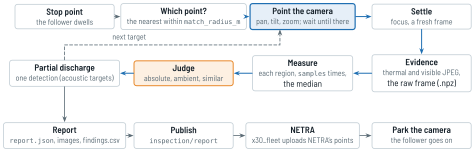
inspection_node runs when the follower reaches a stop point: it finds the inspection points of the site within match_radius_m (1.5 m) of the stop, and for each target moves the PTZ camera, waits, measures and judges.
| Setting | Default | Tune when |
|---|---|---|
camera.move_timeout_sec | 20 s | a long pan fails: the camera is slow in the cold |
camera.settle_sec | 1 s | images blur or the focus hunts: raise to 2 s–3 s at high zoom |
thermal.samples | 3 | readings jump: more samples (the median is used) |
thermal.sample_interval_sec | 0.3 s | the frames are the same: longer |
max_duration_sec | 150 s | a point has many targets: later targets are skipped |
acoustic.duration_sec | 5 s | the acoustic camera needs longer to classify |
Note
max_duration_sec must stay below the follower’s hooks.inspection_timeout_sec (180 s on the X30): otherwise the robot walks on while the camera still works.
10.2 Thermal criteria
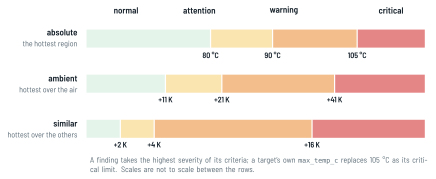
Each target has one or more regions on the thermal image. With thermal.ambient_c), three differences are judged against their levels, after NETA MTS practice:
| Criterion | Attention | Warning | Critical |
|---|---|---|---|
| absolute | 80 °C | 90 °C | 105 °C (or the target’s max_temp_c) |
| ambient | 11 K | 21 K | 41 K |
| similar | 2 K | 4 K | 16 K |
The target’s severity is the highest of its three. A target taught with a rated temperature (max_temp_c in NETRA) uses it as its absolute critical level.
The air temperature is live: set it
rosparam set /inspection_node/thermal/ambient_c 34.
10.2.1 Getting good temperatures
Emissivity: the camera’s setting applies to every target. Bare, oxidized copper and aluminium read far too cold; the similar criterion compares like with like and suffers least.
Distance and zoom: a region needs several pixels of the hot spot; zoom in from the stop rather than teach a closer stop next to the equipment.
Sun and reflections: a reflection of the sun on a busbar is hot to the camera. Patrol thermal routes at night or on a cloudy day where it matters.
Load: a joint’s heating rises with the square of the current. Readings at light load understate a defect; NETRA’s trend over patrols shows it best.
10.3 Partial discharge
The acoustic camera classifies what it hears; each class maps to a severity: acoustic.corona (attention), acoustic.surface (warning), acoustic.floating (critical), noise is normal. intensity_warning and intensity_critical raise a discharge by its intensity as well (0: off): set them after a few patrols, from the intensities the site’s normal corona shows.
10.4 Reports
Every point inspected writes a folder under reports_dir with the readings, the images and, with camera.raw_thermal, the raw temperatures per pixel. The oldest days go while less than reports_min_free_gb (6 GB) is free; reports_keep_days bounds them by age.
10.5 The recorder
recorder_node (perception host) records the cameras during every patrol (patrol.enabled) and on request: the visible and thermal streams as MP4 segments of video.segment_sec, every raw thermal frame with the robot’s pose and the camera’s pan, tilt and zoom, and the acoustic data in chunks.
| Setting | Default | Meaning |
|---|---|---|
disk.min_free_gb | 10 GB | the oldest sessions go while less is free |
disk.stop_free_gb | 3 GB | below this nothing more is written |
disk.check_sec | 30 s | checked this often while recording |
patrol.stop_after_sec | 30 s | after the route ends; laps stay one session |
thermal.min_interval_sec | 0 | every thermal frame; raise it to save disk |
A raw thermal frame holds a temperature for every pixel: at the camera’s full frame rate an hour of patrol fills gigabytes. Set thermal.min_interval_sec to 1 s or more when the raw frames serve trends rather than video.